Notice of Default in California: Timeline, What Happens Next & Your Options
A notice of default is the first formal step in a California foreclosure, but it is not the end of the road. Here is how the timeline works, the deadlines that matter, and the options Contra Costa homeowners have to keep their home or sell on their terms.
What is a notice of default in California?
A notice of default (often called an NOD) is recorded by the trustee named in your deed of trust when a mortgage loan is seriously behind. It formally starts California's nonjudicial foreclosure process, which happens outside of court.
Before it can be recorded, your loan servicer generally must contact you, or make specific attempts to reach you, at least 30 days in advance to discuss options. Once recorded, the notice is mailed to you within 10 business days and becomes a public record.
The notice lists the amount needed to bring the loan current. That amount grows with each missed payment, late fee and foreclosure cost, so acting early matters.
Notice of default at a glance
- What it does
- Starts the formal foreclosure clock
- Time to cure
- At least 3 months after recording
- Earliest sale
- About 3 months and 20 days after recording
- Reinstatement
- Generally until 5 business days before the sale
- After a sale
- Generally no right to buy the home back
Notice of default California timeline
These are the minimum steps under California law. Many foreclosures take longer, and sales are often postponed, but you should plan around the minimums.
- Missed payments and lender outreachUsually 120+ days behind
Your servicer must contact you or attempt to, at least 30 days before recording a notice of default, to discuss ways to avoid foreclosure.
- Notice of default recordedDay 1 of the formal process
The trustee records the notice with the county recorder and mails it to you within 10 business days.
- Three-month reinstatement periodAt least 3 months
You can cure the default, apply for help, or sell. The notice of sale cannot be recorded until close to the end of this period.
- Notice of trustee's sale20+ days before the sale
The notice is posted on the property and in a public place, published once a week for three weeks, and mailed to you. The sale must be at least 20 days after the three-month period ends.
- Trustee's sale (auction)Business days, 9 a.m. to 5 p.m.
Since January 1, 2025, a one- to four-unit home generally cannot be sold at the initial sale for less than 67% of its fair market value; if no qualifying bid is made, the sale is postponed at least seven days.
Notice of default timeline: key deadlines
| Deadline | What it means for you |
|---|---|
| 3 months after the notice of default | The earliest point the trustee's sale can be set in motion. Use this time to catch up, apply for help or sell. |
| 5 business days before the sale | Your right to reinstate the loan generally ends, and it is the deadline for a complete loan modification application or a listing agreement to trigger protections. |
| Listing agreement with a licensed broker | Delivered to the trustee at least 5 business days before the sale, it generally postpones the sale 45 days, once. A qualifying purchase agreement can postpone it another 45 days, once. |
| After the trustee's sale | Generally no right to redeem the home. Any surplus after paying the lender and other lienholders goes to the former homeowner. |
Notice of default and foreclosure: what happens after it is recorded
You will hear from a lot of people. Because the notice is public, investors, companies and agents often reach out. Some are helpful; some are scams. Never pay upfront for a loan modification, never sign over your deed to someone promising to "save" your home, and never stop paying your lender on someone else's advice.
You still have protections. If you submit a complete first-lien loan modification application at least five business days before a scheduled sale, the servicer generally cannot move forward with the sale while it is under review. Ask for everything in writing.
Time is your most valuable asset. The earlier you act, the more options stay open, especially if you have equity you want to protect.
Free, trustworthy help
- HUD-approved housing counselors are free: (800) 569-4287
- Verify any real estate licensee at dre.ca.gov
- Report suspected scams to the California Attorney General
Your options after a notice of default
Ways to keep your home
- Reinstatement: pay the past-due amount, fees and costs in one payment
- Repayment plan: catch up over several months
- Forbearance: a temporary pause or reduction in payments
- Loan modification: new loan terms you can afford
- Refinance or family help if you have strong equity
Ways to move forward on your terms
- Sell with equity: pay off the loan and keep what is left
- Short sale: sell for less than you owe, with lender approval
- Deed in lieu: transfer the home to the lender in exchange for release
- Talk with an attorney about legal options, including bankruptcy
If part of your mortgage is forgiven through a short sale, deed in lieu or modification, the forgiven amount may be taxable. Talk with a tax professional before you sign.
Notice of default in Contra Costa County
In Contra Costa County, notices of default and notices of trustee's sale are recorded with the County Clerk-Recorder at 555 Escobar Street in Martinez. Before a sale, the notice must also be posted on the property and in a public place in the city where the sale will be held, and published in a local newspaper.
Notice of default in Antioch
Homeowners in Antioch (94509, 94531) follow the same California timeline, with notices recorded in Martinez. Antioch real estate · free options guide
Notice of default in Brentwood
Homeowners in Brentwood (94513) follow the same California timeline, with notices recorded in Martinez. Brentwood real estate · free options guide
Notice of default in Oakley
Homeowners in Oakley (94561) follow the same California timeline, with notices recorded in Martinez. Oakley real estate · free options guide
Notice of default in Pittsburg
Homeowners in Pittsburg (94565) follow the same California timeline, with notices recorded in Martinez. Pittsburg real estate · free options guide
Notice of default in Richmond
Homeowners in Richmond (94801, 94804, 94805) follow the same California timeline, with notices recorded in Martinez. Richmond real estate · free options guide
Notice of default in San Pablo
Homeowners in San Pablo (94806) follow the same California timeline, with notices recorded in Martinez. San Pablo real estate · free options guide
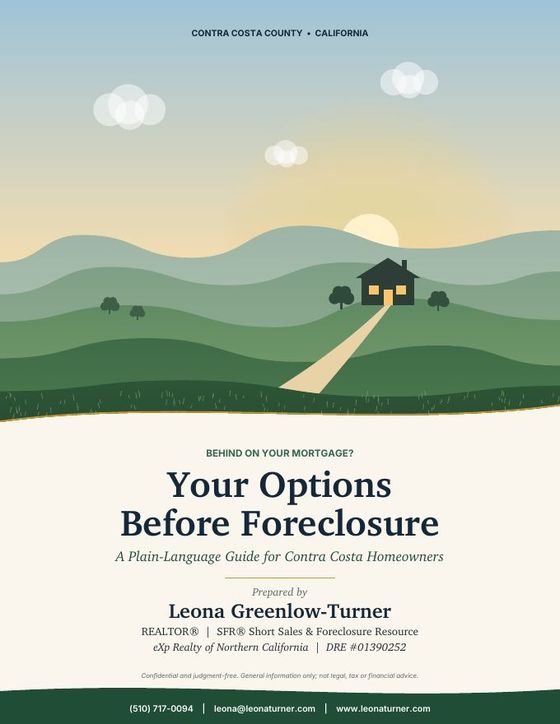
Your Options Before Foreclosure
A plain-language guide for Contra Costa homeowners: the timeline, ways to keep your home, selling to protect your equity, scam warnings and a step-by-step checklist.
Get the free guideNotice of default FAQ
What is a notice of default in California?
A notice of default is the document a trustee records with the county recorder to formally start a nonjudicial foreclosure. It states that the loan is in default and how much is needed to bring it current. In Contra Costa County it is recorded with the County Clerk-Recorder in Martinez and becomes a public record.
How long after a notice of default is the foreclosure sale in California?
At minimum, about three months and 20 days. The homeowner has three months after the notice of default is recorded to cure the default, and the trustee's sale must be at least 20 days after that period ends. In practice the process often takes longer, but you should never count on extra time.
Can I stop a foreclosure after a notice of default?
Often, yes. You can generally reinstate the loan by paying the past-due amount, fees and costs until five business days before the sale. A repayment plan, forbearance or loan modification may also resolve the default, and submitting a complete loan modification application at least five business days before a scheduled sale generally requires the servicer to review it before selling.
Can I sell my house after a notice of default?
Yes. Selling before the trustee's sale lets you pay off the loan and keep any remaining equity. Under a California law effective January 1, 2025, giving the trustee a listing agreement with a California licensed broker at least five business days before the sale generally postpones the sale 45 days, once, for one- to four-unit homes.
What happens if the home is sold at a trustee's sale?
After a nonjudicial trustee's sale, California generally gives no right to buy the home back, and lenders generally cannot pursue a deficiency judgment for the remaining balance. If the sale brings in more than is owed to the lender and other lienholders, the remaining surplus is paid to the former homeowner.
Does a notice of default hurt my credit?
The missed payments that lead to a notice of default are typically reported to the credit bureaus, and a completed foreclosure usually has a larger and longer-lasting impact. Resolving the default early, or selling before a sale date, can limit the damage. A HUD-approved housing counselor can review your situation for free.
Sources: California Civil Code sections 2923.5, 2923.6, 2924, 2924b, 2924c, 2924f, 2924g and 2924k; California Code of Civil Procedure section 580d; Nolo, California Foreclosure Laws and Procedures. Updated November 2026. This page is general information, not legal, tax or financial advice. Leona Greenlow-Turner is a licensed real estate agent and does not provide loan modification services or charge advance fees.
Received a notice of default?
Call or text (510) 717-0094 for a private, judgment-free conversation about your timeline, your equity and your options.